The Origin Story on a Menu Is Not the Whole Food History
A menu’s food origin story can hide migration, adaptation, and local habits. Learn how to read the claim carefully and what questions to ask.
A menu’s food origin story can make a layered tradition sound like a single invention. If you are trying to understand a dish rather than settle a dispute over who “owns” it, start by asking what kind of origin the menu actually means: a first known version, a name, a technique, or the form served here today.
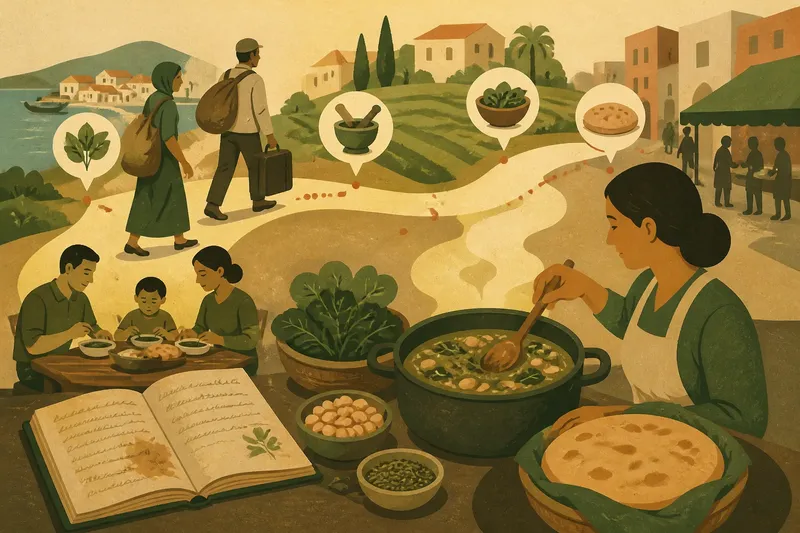
That distinction matters because food travels with people, ingredients, tools, and habits. A dish may take shape across several places, with each community altering it for what is available and familiar. The clearest account is often not a single birthplace but a sequence of changes.
What does a menu mean by a dish’s origin?
“Origin” can point to different things. It might mean the earliest surviving written recipe, the region associated with a recognizable version, the source of a name, or the place where a restaurant’s particular recipe was developed. These claims are not interchangeable.
A menu that says “from the coastal villages” may identify a tradition, not prove that every version began in one village. “Inspired by” signals interpretation, while “traditional” usually needs context: traditional to whom, in which community, and in what form? A short menu line may not have room to explain those distinctions, but a careful reader can avoid treating it as a complete account.
Think of a dish’s history like a well-used recipe card: the handwriting, stains, and revisions all matter, not just the name at the top. The card does not tell you every cook who changed it, but it can show that the recipe was never as fixed as the title suggests.
Which situation fits the way you want to read the story?
- You want a quick sense of place. Treat a regional label as a useful starting point. It may tell you the style or community the restaurant is invoking, even if it does not identify a sole inventor.
- You are checking a specific historical claim. Look for the claim’s scope. “The first recorded recipe” is narrower and more checkable than “the dish was invented here.” Ask what record, version, or period the wording refers to.
- You want to know how the dish became familiar locally. Focus on migration, markets, and home cooking. The version people recognize in one city may have developed there through families and businesses adapting a remembered dish.
- You are choosing what to order, not adjudicating history. Read the origin line as a description of the restaurant’s approach. If the ingredients, preparation, or flavor sound appealing, you can enjoy the dish without treating the menu copy as a definitive historical verdict.
- You are writing or repeating the story. Use qualified language such as “associated with,” “developed in,” or “one version traces to,” when the evidence supports a connection but not a sole origin. This keeps the account informative without turning uncertainty into a false certainty.
How do migration and local habits change a dish?
People carry culinary knowledge when they move, but they do not carry every ingredient or kitchen condition with them. A cook may substitute a locally available grain, change a cooking vessel, or adjust seasoning to match family preference. Over time, a practical adaptation can become a recognizable local style.
Local habits matter just as much as supply. A dish may be served at a different meal, paired with a new side, or made more or less rich to fit how people eat it. Restaurants can further reshape a familiar preparation for their kitchen, customers, or menu format. Those changes do not automatically make the dish less meaningful; they tell part of its continuing history.
Say a family moves to a town where the leafy ingredient used in a familiar stew is hard to find. They make it with a locally sold green, keep the cooking method and seasoning they value, and serve it with the town’s everyday bread. The observable result is a version that preserves some remembered features while reflecting the family’s new surroundings. That imagined situation is not proof of any particular dish’s history; it shows the kinds of decisions that can create regional variation.
Be cautious about language that makes adaptation sound like a one-way act of “improvement.” Communities influence one another, and the people doing the adapting may have different reasons: availability, cost, taste, religious practice, or convenience. A menu can acknowledge a connection without implying that one version is the authentic standard and all others are deviations.
What questions help separate history from menu storytelling?
Does “invented here” identify a person, place, or record?
Ask what “here” refers to and what evidence supports the claim. A restaurant’s neighborhood, a city, and a broader region are different scales, and an origin claim may become less precise as its geography expands.
Is the menu describing a tradition or this kitchen’s version?
Words such as “our,” “inspired,” or “house-style” often describe the restaurant’s preparation rather than a historical origin. Read those terms as information about the dish being served, not a claim that the kitchen created the wider tradition.
Does the story acknowledge more than one community?
A useful account may name the people, places, or routes involved without forcing them into a single inventor narrative. If it leaves out those connections, treat the story as abbreviated rather than complete.
What would make the claim more specific?
Look for a named version, ingredient, technique, or source of the claim. Specific details make it easier to distinguish a documented association from a broad promotional phrase.
How can you discuss food history without flattening it?
Use language that fits what is known. “Commonly associated with” describes a strong connection without claiming exclusive ownership. “A version developed in” leaves room for earlier influences or parallel preparations. “The restaurant’s take on” clearly locates the claim in the present kitchen.
When a story involves several communities, name the layers you can support: an ingredient’s route, a cooking technique, a migration pattern, or a local serving custom. Avoid attaching a long list of origins merely to sound comprehensive. If you cannot verify a detail, leave it out or frame it as an open question rather than presenting it as settled fact.
Food history also includes ordinary, unrecorded choices. Home cooks may adapt recipes without writing them down; vendors may alter a preparation to suit customers; a dish may become familiar under a new name. The absence of a single neat document does not mean there was no history. It means the available story may be partial, and a menu’s brief wording cannot fill every gap.
For a food origin story, the useful question is not always “Where did it begin?” It may be “Which version is this, whose habits shaped it, and what does the menu actually claim?” That approach lets you appreciate a dish and its local character while keeping the origin story in proportion to what it can tell you.