What “Natural” on a Food Label Actually Tells You
Natural on a food label is a limited claim, not a full ingredient or processing account. Learn which label details to check before choosing a product.
What does “natural” on a food label tell you? In the United States, the Food and Drug Administration (FDA) describes its general policy as applying to foods without added artificial or synthetic substances that would not normally be expected in them. The phrase does not, by itself, explain every ingredient’s source, a product’s full processing history, or whether it fits your needs.
Think of “natural” as a small sign on a jar, not a window into the factory. It can prompt a closer look, but the product name, ingredient list, Nutrition Facts panel, and any specific certification or disclosure answer different questions.
What does “natural” mean on this package?
The FDA’s general policy describes “natural” in terms of added artificial or synthetic substances, while recognizing that the term can be difficult to apply to foods with multiple ingredients and processing steps. The U.S. Department of Agriculture (USDA) also has its own rules for certain meat and poultry labeling claims. The applicable agency and requirements can depend on the product, so a broad summary should not be treated as a complete product-specific ruling.
The word alone does not mean that a food is organic, locally grown, minimally processed, additive-free, or nutritionally superior. Those are separate questions. A familiar ingredient can be processed, and a product labeled “natural” can still contain sugar or sodium.
Nor does the phrase provide a full sourcing history. It does not identify a farm, growing practice, or place of origin unless the package gives that information separately. Treat it as one claim to interpret, not as a certificate that answers every question a shopper might have.
Which part of the label should you read next?
Start with the statement of identity: the words that name the food. “Fruit drink,” for example, describes a different kind of product from “fruit juice.” The product name helps establish what is being sold, regardless of the size or prominence of a front-panel claim.
Next, read the ingredient list from beginning to end. Ingredients are generally listed in descending order by weight, so those near the beginning make up more of the product than those farther down. The list can clarify whether the product includes fruit, grain, oil, sweetener, or another ingredient, but it does not necessarily explain each ingredient’s source or production history.
Check the Nutrition Facts panel for the nutrients and serving information relevant to your choice. “Natural” does not tell you the amount of added sugar, sodium, or saturated fat in a serving. Compare the same listed nutrients across products you are considering, using each panel’s serving information.
Finally, read allergen disclosures and other statements that matter to you. Do not infer safety from a broad claim on the front. If you have a food allergy or another medical dietary need, ask a qualified health professional how to interpret labels for your situation.
What can the front claim leave unanswered?
- Which ingredients are included? Check the ingredient list. If it names an ingredient you want to avoid, choose another product; if it does not, continue checking the information relevant to your choice.
- How much of a nutrient is present? Check the Nutrition Facts panel and serving information. If the listed amount does not fit your preference, compare another product; if it does, consider the other details that matter.
- Is the food certified organic? Look for the applicable organic wording and certification information. If it is absent, do not treat “natural” as proof of organic status; if present, read the details of the claim.
- Where did the ingredients come from? Look for a separate origin statement or ask the maker. If you cannot confirm the origin and it matters to your choice, select a product with clearer sourcing information; otherwise, weigh the details you do have.
- How was the food processed? Look for a specific process description or ask the manufacturer. If the package does not provide the detail you need, do not infer it from “natural”; choose a product with clearer information or set that criterion aside.
- Does the label address an allergy or dietary need? Read the relevant ingredient and allergen information. If it is unclear, do not rely on the front claim; seek clarification from the manufacturer or a qualified health professional before deciding.
These are distinct questions. If a particular feature matters—such as a named ingredient, certification, or nutrient level—look for that information directly instead of treating “natural” as shorthand for it.
How can two “natural” products differ?
Imagine you are choosing between two bottled dressings. For this invented comparison, suppose both carry “natural” on the front. The first ingredient list begins with oil and vinegar; the second begins with water and lists sweetener farther down. Your action is to read each list in order, then check the Nutrition Facts panels for the same nutrients and serving information. The observable result is a clearer comparison of what each dressing contains; you can then choose the one that suits your recipe and preferences, while recognizing that the shared claim does not make their compositions alike.
You might still prefer the second dressing because you like its taste, or the first because its ingredient profile fits your cooking. That preference is yours. The label helps identify what is present, but it does not decide which product is better for every person or meal.
Product categories matter, too. A “natural” claim on a snack, drink, or prepared meal does not make those foods interchangeable. Compare products serving the same purpose, then decide which listed ingredients and nutrition details matter for that choice.
How should you compare natural food labels?
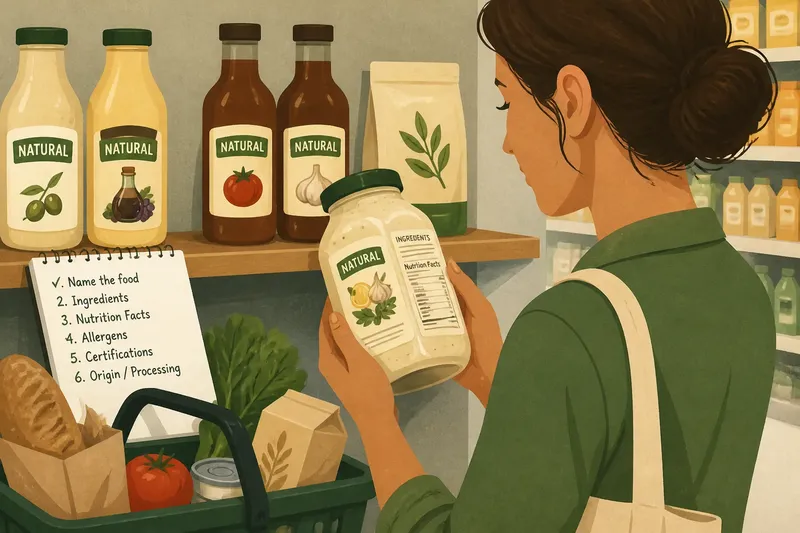
Use this routine when two products make the same broad claim:
- Name the food. Read the statement of identity. If the products are different kinds of food, compare them only if that distinction fits your choice; otherwise, find products in the same category.
- Scan the ingredient lists. Check the first few ingredients and anything you specifically want to seek or avoid. If a listed ingredient conflicts with your needs, set that product aside; if not, continue to the next check.
- Compare relevant nutrition details. Match the same nutrients and serving information across products. If one panel better fits your preference, keep it in consideration; if neither fits, look for another option.
- Verify a specific claim. If you want organic certification, sourcing, or allergen information, look for that detail directly. If it is missing or unclear, do not infer it from “natural”; seek clarification or choose a product with clearer wording.
- Separate label facts from preference. Consider taste, cooking use, and other priorities after checking the package. If the label details do not distinguish the options for your needs, make the choice based on the preference that matters to you.
For a claim whose meaning affects your decision, check the package and relevant manufacturer information. The wording and applicable requirements can vary by product; the front claim alone cannot settle every product-specific question.
What do shoppers ask about natural food labels?
Does natural mean organic?
No. “Natural” and “organic” are distinct claims, and the first does not establish that a product meets organic certification requirements. Look for the specific organic wording and certification information if that is what you want to verify.
Does natural mean a food has no additives?
Not necessarily. The claim is not a complete inventory of ingredients or a promise that no additives appear. Read the ingredient list for the substances included in that product.
Does natural mean minimally processed?
The word alone does not describe every processing step. If processing is central to your choice, seek a specific description from the package or manufacturer rather than reading a process claim into “natural.”
Can a natural product still contain added sugar?
Yes. Check the ingredient list for sweeteners and the Nutrition Facts panel for the relevant sugar information. The front claim does not tell you how much sugar a serving contains.
When is the word useful to you?
It can be a prompt to look closer, especially if the maker provides additional details nearby. A clear ingredient list, relevant nutrition information, and a specific certification or sourcing statement each address a distinct question. The front phrase may catch your eye, but those supporting details carry more of the information you can use.
It can also be irrelevant to your decision. If you are choosing cooking oil for a recipe, the oil type and intended use may matter more than a broad front-panel claim. If you are comparing packaged foods for a dietary need, ingredient and allergen information may take priority.
Read “natural” on a food label as a limited claim, then turn to the details that address your actual concern. When the distinction depends on a particular product or regulated category, consult the relevant agency’s current guidance or ask the manufacturer for clarification rather than assuming the general description settles the question.